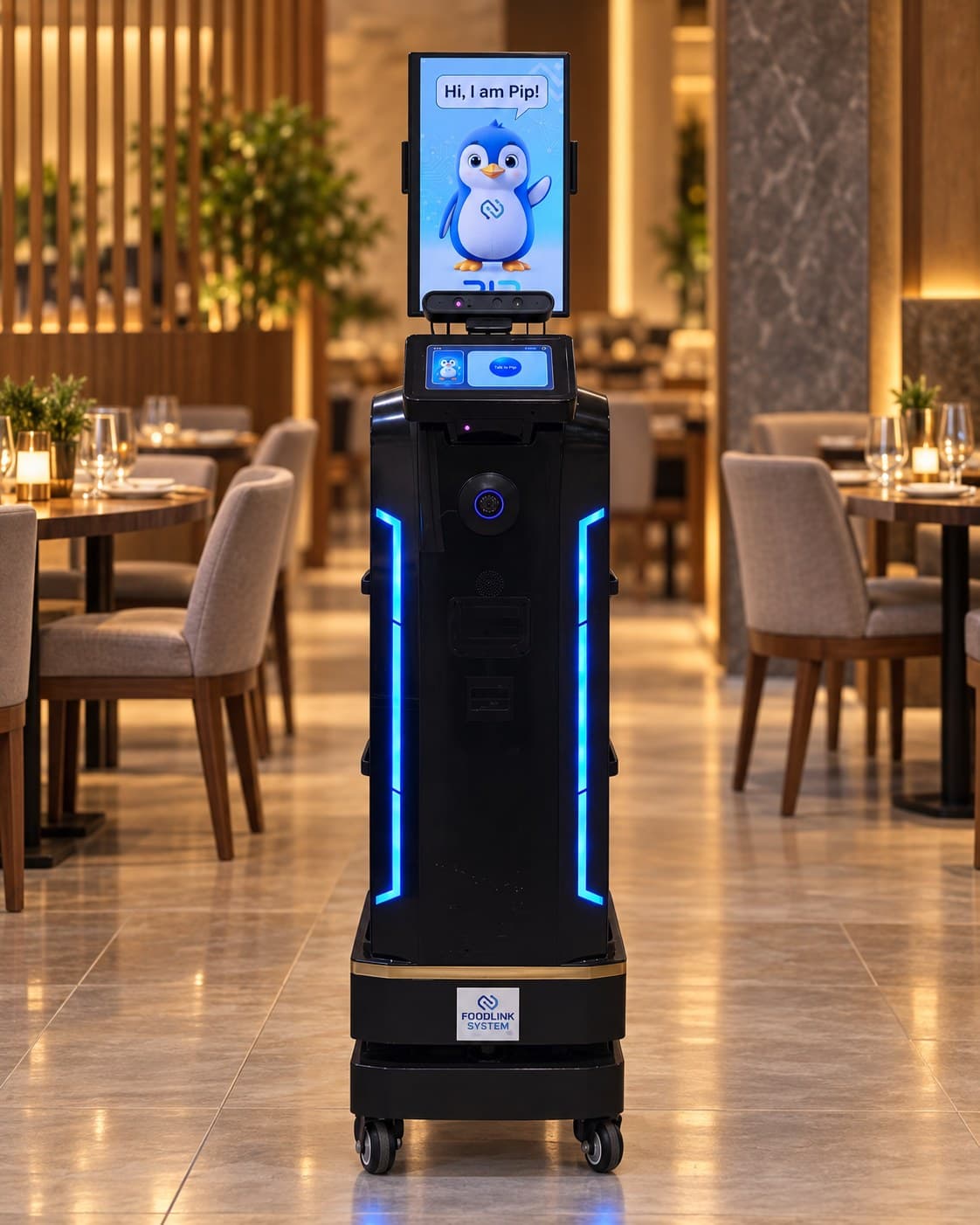
Cover: the real FL1 with Pip on screen. The restaurant setting is an illustration.
Restaurants and shops hear about chatbots, robot waiters and AI agents. The names describe different things, but they can be parts of the same system.
The short answer
A chatbot is a conversational interface. A robot waiter is hardware that moves around a venue. An AI agent is software that chooses steps towards a goal and acts through connected tools, within rules you set.
A chatbot can include agent capabilities, and a robot can include conversational software. What the whole system can do depends on its tools, information and rules.
What is a chatbot?
A chatbot is a conversational interface, often found on websites, WhatsApp and booking pages. Basic FAQ chatbots are reactive: a customer asks, and they reply from supplied information.
- A basic FAQ chatbot answers common questions.
- Some chatbots support voice as well as text.
- A chatbot connected to an agent can also help carry out tasks, within the tools and permissions available.
Chatbots are good for questions before the visit: opening hours, location, "do you take bookings?"
What is a robot waiter?
A robot waiter, or service robot, is a machine that moves around your venue. Most carry food from the kitchen to a table, or collect dirty dishes.
- It follows a route to a table number.
- It stops for people and chairs in its way.
- Some models also include conversational software or an AI agent.
A robot waiter can save walking. Conversations, recommendations and feedback invitations depend on the software and setup included.
What is an AI agent?
An AI agent is software that works towards a goal, not just a reply. It takes in what is happening, decides the next step inside the limits you set, and then acts.
In a physical venue, possible inputs and actions include:
- Sees: notices when someone comes near, and how many people there are.
- Listens: understands spoken questions, in more than one language.
- Decides: picks what to say or do next, using your rules and your information.
- Acts: shows a QR code or hands the customer to your staff, if those tools are connected and allowed.
Vision and voice are examples, not requirements for every agent. An agent can work with text or system events too. Its abilities depend on its connected tools and rules; a chatbot interface can be how a customer interacts with it.
Side by side
| Chatbot | Robot waiter | AI agent | |
|---|---|---|---|
| What it is | A conversational interface | Physical hardware | Software working towards a goal |
| Where it works | Messaging, websites or voice interfaces | Your floor | Digital systems or physical venues |
| What starts it | Usually a customer message; setup varies | Staff or connected software | A request or event, within configured rules |
| What it does | Replies; may include agent capabilities | Carries and moves; may include conversational software | Chooses steps and acts through available tools |
| Good for | Customer questions and connected tasks | Saving walking | Tasks supported by its tools, information and rules |
Do you need a robot to have an AI agent?
No. An agent can work entirely through digital systems. In a restaurant or shop, a robot can give it a way to move to customers and interact through screens, microphones and speakers.
Pip is the conversational AI agent that powers FL1. FoodLink System builds the software and robot experience together. FL1 is the robot body Pip runs on: it moves, finds its way and carries trays. You can read more about how the two fit together on our products page.
What an AI agent does in a venue today
Pip's work falls into four areas. Each venue chooses which jobs to enable:
- Google reviews: invites customer feedback and displays a review QR code.
- Recommending: suggests a dessert, a drink, an add-on or a service, then stops when told no.
- Your campaign: plays your video on the tall screen, then answers questions about it.
- Handover to staff: hands the customer to a person at the point you choose.
At Sour Little 7 in Sibu, the FeedMe POS connection supports Pip in deciding when to visit tables, as described in the case study. At Toyako salon, it explains services to customers in Malay. The customer stories show both.
Seven questions to ask any vendor
Before you pay for "AI", ask:
- Does it act, or only talk? Ask what it can do besides answer questions.
- What systems does it connect to? POS, QR codes, your staff? Or nothing?
- Who sets its limits? You should decide what it may say, and what it must never say.
- How does it hand over to staff? And at which point?
- How does it handle images and identity? Does it capture images or recognise people's identities? How is consent requested? What is retained, for how long, and who can access it?
- What do you see afterwards? Ask for a dashboard of what it did and what customers asked.
- Can you try it before you commit? A short trial at your own venue tells you more than any demo.
Frequently Asked Questions
Q: Can a chatbot include an AI agent?
Yes. The chatbot is the conversational interface; an agent behind it can choose steps and act through connected tools. Ask which actions are actually enabled and what rules limit them.
Q: Will an AI agent replace my staff?
It should not. A good agent takes the repeated questions and the asking nobody has time for: reviews, add-ons, the offer of the week. It hands the customer to your team at the point you choose.
Q: Is an AI agent expensive to set up?
It depends on the venue and what the agent needs to do. At FoodLink System, every venue gets its own quote, and you start with a 3-month pioneer phase you can cancel in those 3 months with no penalty.
Explore FoodLink System's products to see how Pip and FL1 could fit your venue.