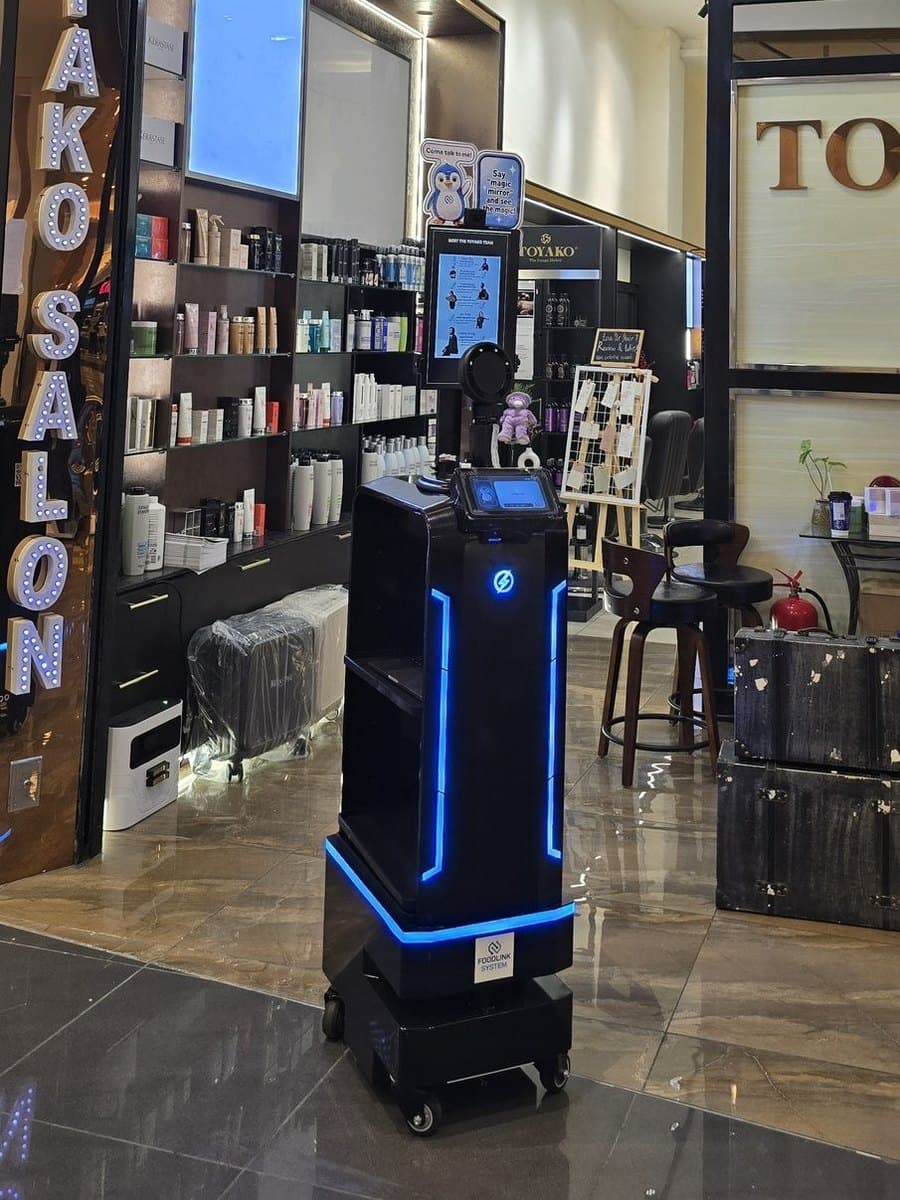
Cover: FL1 at the entrance of the Toyako salon, AEON Mall Tebrau City, Johor Bahru, 30 August 2026.
Most talk about service robots is about restaurants: trays, tables, food going out to the right seat. A hair salon has none of that. Nobody needs a plate carried to them, and the work happens in the chair, by hand.
Toyako is a hair salon chain in Johor. Since late August 2026, our FL1 robot has stood at the entrance of their salon in AEON Tebrau City, running Pip, the AI agent we build at FoodLink System. This post is about what Pip actually does there, where we told it to stop, and what other shops can take from it.
The short answer
At Toyako, Pip works the door. It greets people walking past, explains the salon's services in the customer's own language, shows what a treatment looks like on FL1's tall screen, and lets customers preview a new hairstyle on their own photo with Magic Mirror. It does not quote final prices or make bookings. When a customer is ready, Pip hands them to the salon team.
Here is the reel we made with Toyako, filmed at the salon:
Why a salon is a different job
In a restaurant, most customers already know why they came in. In a salon, a lot of the decision happens before anyone sits down. People stand at the entrance and wonder: what is a head spa, how long does a perm take, would this cut suit me, do they do my hair type?
Those are fair questions, but the stylists are busy with the customer in the chair. So the questions often go unasked, and the person walks on.
That gap, between walking past and talking to a stylist, is where we put Pip.
What we loaded into Pip
Pip only says what it has been given. For Toyako we loaded:
- The company story, and four branches with their opening hours
- Every service, and how long each one takes
- How the price changes, and what it must never quote
- Topics it must never discuss
- One person to hand the customer to, and a rule that it guides bookings but never makes them
The limits matter as much as the information. A salon price depends on hair length, condition and what the stylist finds, so Pip gives the approved starting prices, explains what the price depends on, and leaves the final number to the team.
What Pip does at the door
A customer walks up and starts talking. Pip answers in the language they use. In the photo below, it explains Toyako's hot stone scalp treatment in Malay, while FL1's tall screen plays the treatment so the customer can see what they are agreeing to.
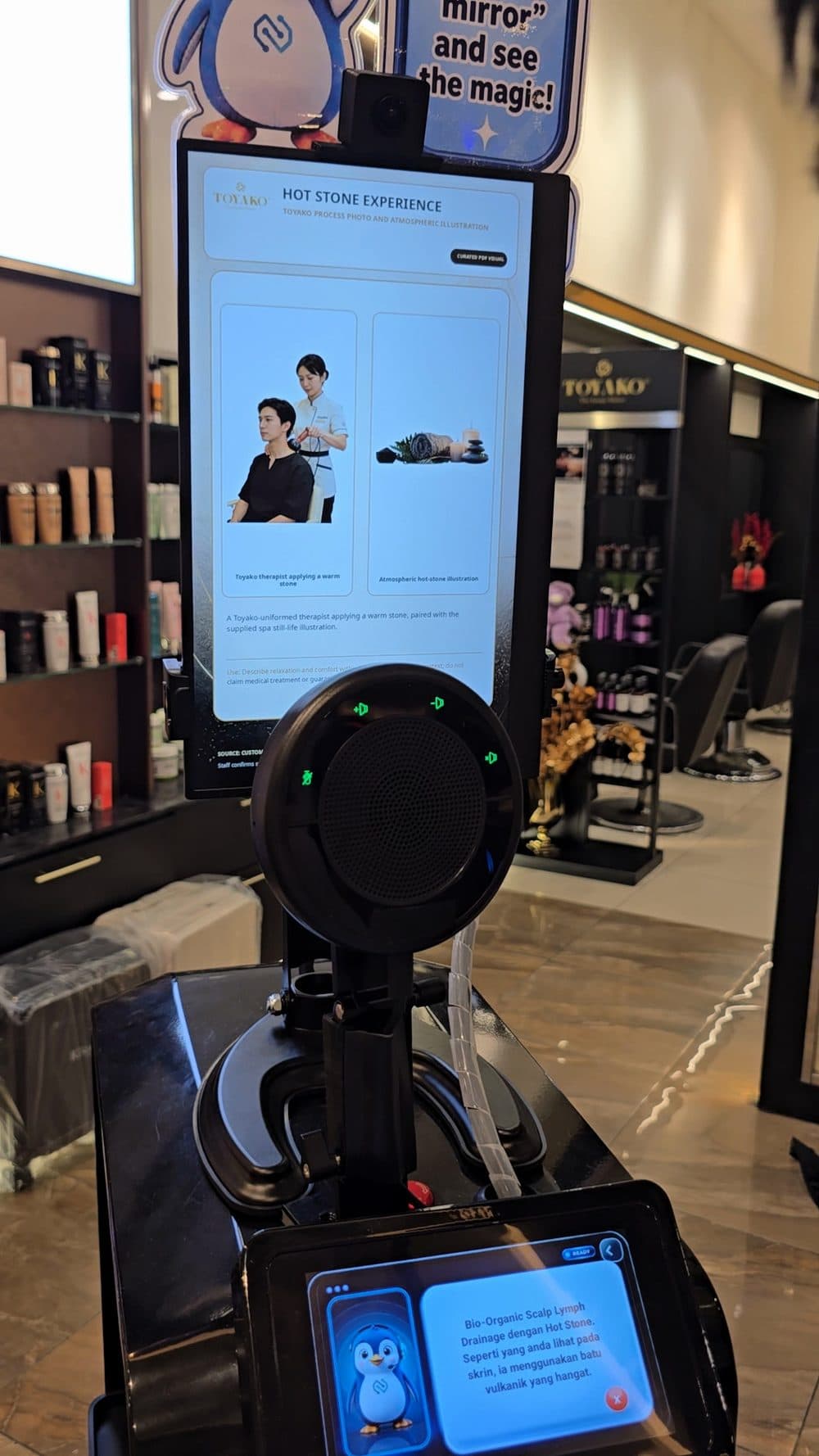
Pip explains an approved hot stone treatment, with the service on screen. Toyako, 1 September 2026.
The screen is half the job. A scalp treatment is hard to picture from words alone. Seeing it, while Pip answers "how long" and "is it suitable for oily scalp", is what moves someone from curious to interested.
Magic Mirror: see the haircut before the haircut
We built Magic Mirror for Toyako. It gives people a reason to stop, even when they had no plan to ask about anything.
- A customer says "magic mirror".
- They pick one of twelve hairstyles on the touch screen, or show a reference photo from their phone.
- With their consent, Pip counts down and takes their photo.
- A few moments later the tall screen shows them with the new look, and a QR code lets them keep the picture.
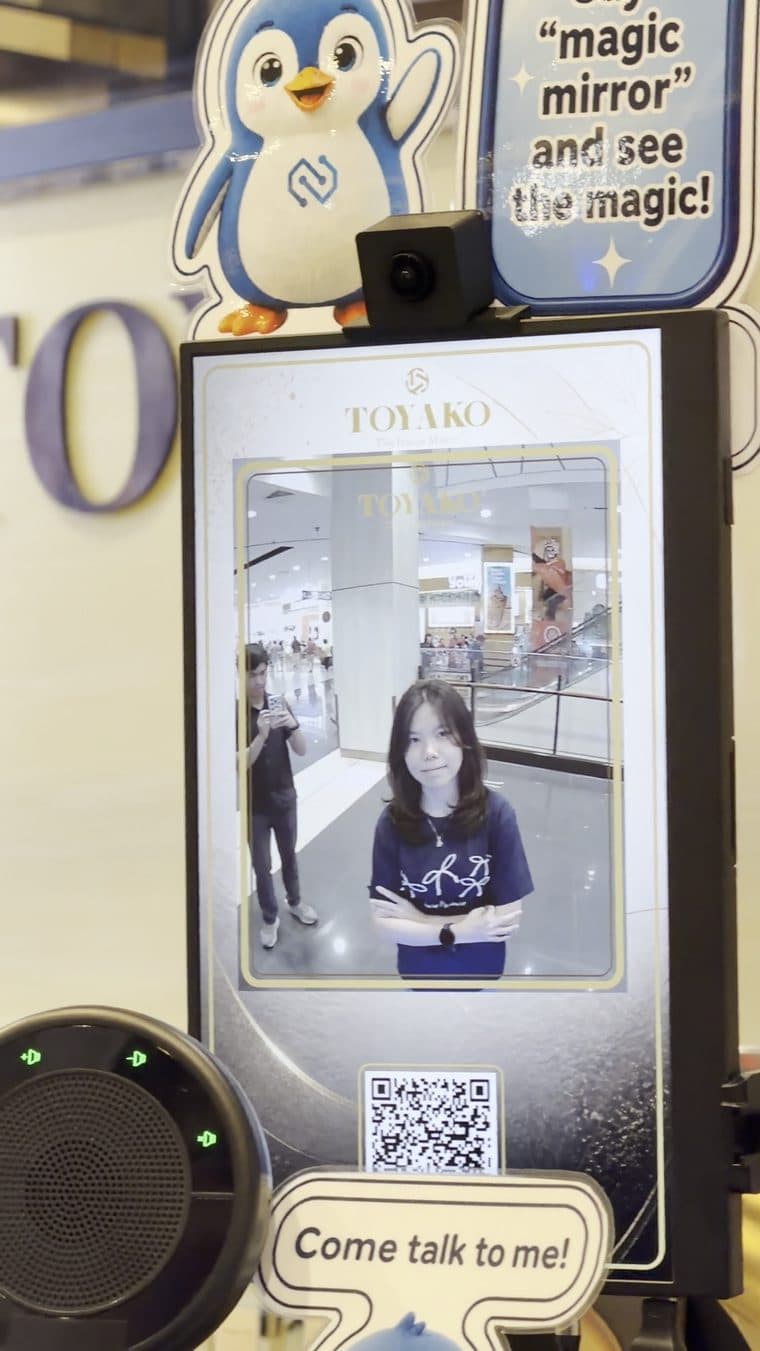
A Magic Mirror result during a function test at Toyako on 5 September 2026. The person is a tester, not a customer.
In the first two and a half weeks, about one in six conversations Pip had at Toyako mentioned Magic Mirror: 84 of 514 summarised conversations between 28 August and 13 September 2026. A preview does not replace a stylist's judgement, so a stylist still confirms whether the style works for that person's hair, and what it costs.
The hand-off, and what the owner sees
Pip's last job in most conversations is to get out of the way. When a customer wants to book, Pip tells them it can't make the booking itself and points them to the salon team.
Every conversation is summarised for the owner: what the guest asked about, what Pip helped with, and whether anything needs a follow-up. Here is one, with nothing personal in it:
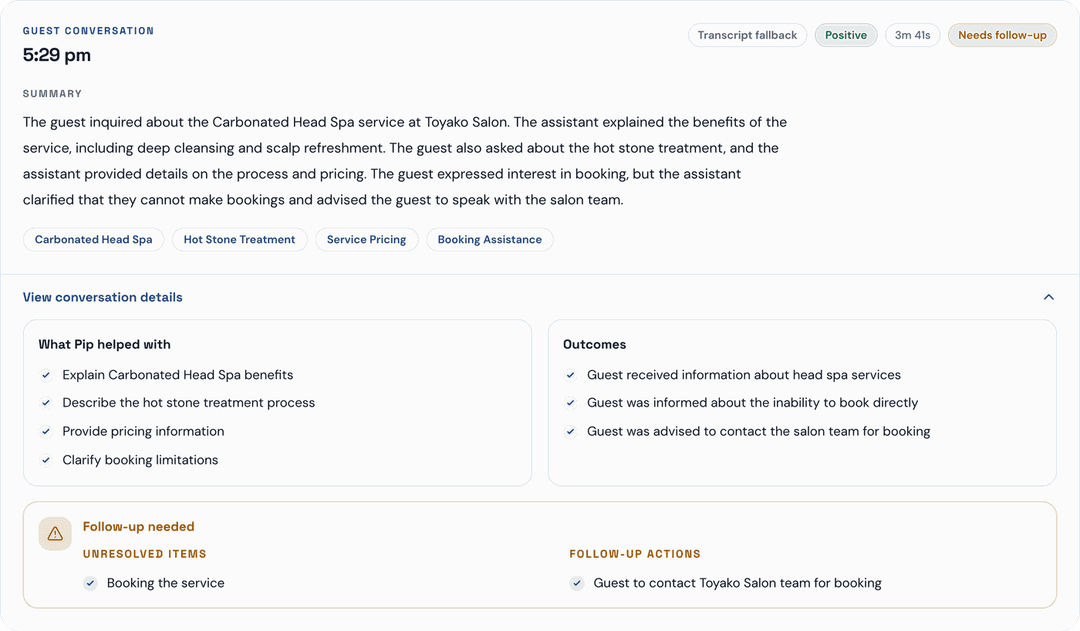
An anonymised conversation summary from the Toyako dashboard.
That summary tells the salon two useful things. Which services people ask about at the door, and which conversations ended with someone wanting to book. Both are things a salon normally never hears about, because the person never came in.
What we don't claim
We have not measured a rise in bookings or sales at Toyako, so we don't claim one. What the deployment shows is the pattern: people stop, they ask real questions about real services, they play with Magic Mirror, and the ones who are ready get handed to a stylist. We will publish figures when we have measured them properly.
What other shops can take from this
Nothing at Toyako looks like a restaurant, and that is why we like it as an example. The same four pieces work in a beauty counter, an optical shop, a clinic lobby or a showroom:
- Load your own information. Services, products, hours, what is in stock. Pip answers from that, not from guesswork.
- Set the limits. What it must never quote, never promise and never discuss.
- Name one hand-off. The person or counter that takes over when the customer is ready.
- Add one thing worth stopping for. At Toyako it is Magic Mirror. In a shop it might be a product finder, a quiz, or a voucher.
Frequently asked questions
Can a robot book appointments for a hair salon?
That depends on the salon's booking system and what the salon wants. At Toyako we set a clear rule on purpose: Pip guides customers towards a booking but never makes one. The salon team takes every booking, so nothing gets double-booked or promised that a stylist can't deliver.
What languages does Pip speak in the salon?
Pip answers in the language the customer uses. At Toyako we have recorded conversations in Malay, English and Mandarin, but those are examples, not a limit.
Does Magic Mirror keep the customer's photo?
Magic Mirror only takes a photo after the customer agrees, and the QR code lets them save their preview. Ask us how photos are stored and for how long before you switch it on in your own shop, so it matches your privacy notice.
Does Pip quote salon prices?
Only what the salon allows. At Toyako, Pip gives the starting prices the salon approved, explains what the final price depends on, such as hair length and the treatment chosen, and a stylist confirms the final price.
How much does a robot like this cost for a salon?
We quote every venue on its own, based on the robot, how long you need it and what Pip needs to do. WhatsApp us with your shop and what you want Pip to handle.
Read the full Toyako customer story, see how Pip works on any robot, or look at the greeter robots built to work the door.