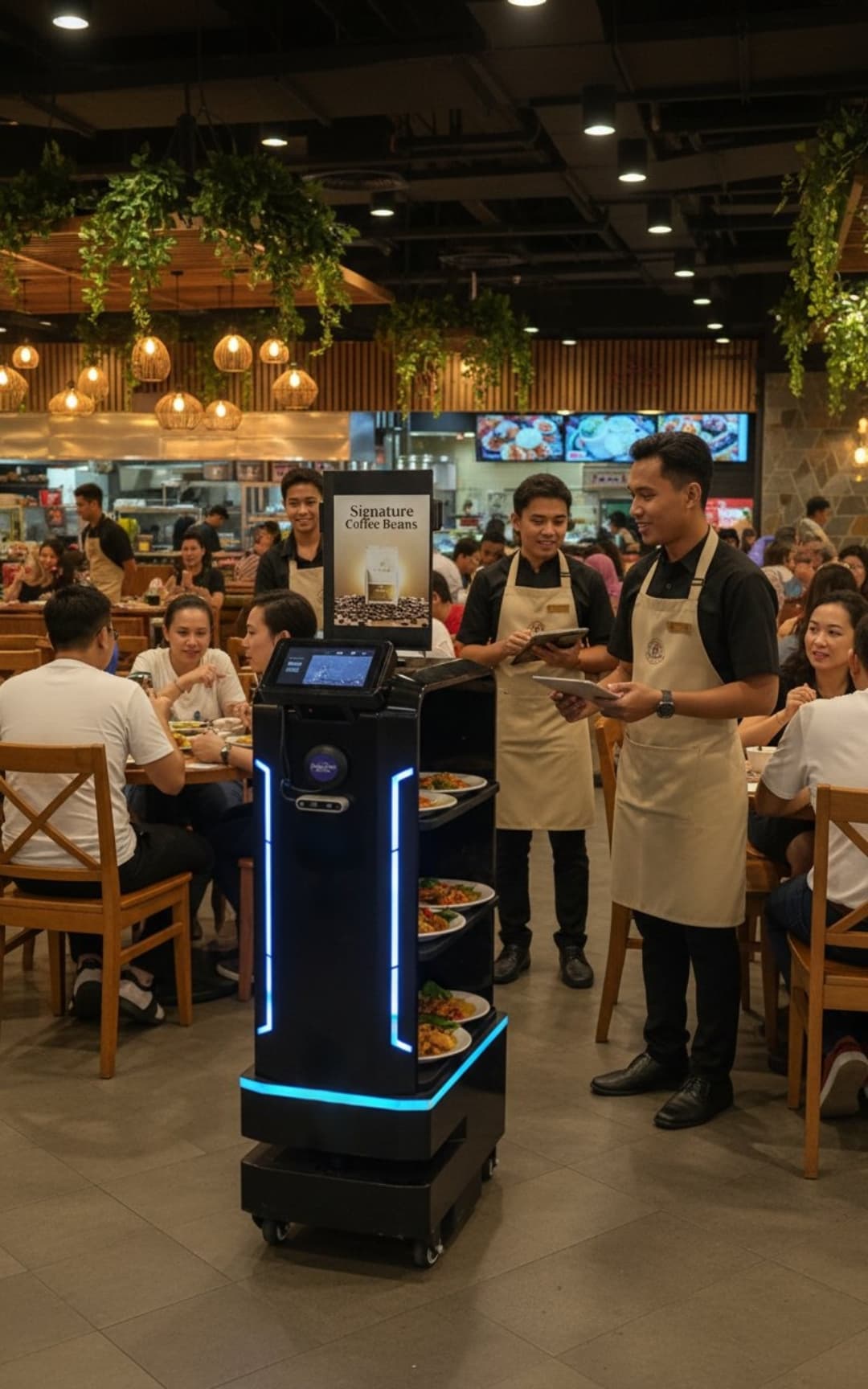
If you're running a restaurant in Malaysia right now, you've almost certainly dealt with this. You post a job. Few or no responses. You scramble to cover shifts with existing staff. You watch your team burn out from carrying positions you can't fill. This isn't a temporary blip. It's a structural shift in the Malaysian labour market that every F&B operator needs to understand and adapt to.
The 2025 minimum wage increase to RM 1,700 put more pressure on margins without fixing the underlying problem. If anything, the wage floor moving up made the cost of chronic understaffing worse for operators who weren't already paying above it.
Below is a breakdown of why the shortage is happening, what it's costing your business in 2026 specifically, and what practical solutions working operators are using.
Why is there a staff shortage in Malaysian F&B?
The work perception problem
F&B work has a perception problem in Malaysia. Long hours, physically demanding conditions, weekend and public holiday shifts, and pay that hasn't kept pace with the cost of living have made the industry less attractive to younger Malaysians who have more options than previous generations. Some industry estimates point to hundreds of thousands of unfilled positions across the sector.
This isn't a judgment on the industry. It's a structural reality driven by demographics, economic development, and shifting expectations about what constitutes acceptable working conditions.
Post-pandemic behavioral shifts
The pandemic accelerated a fundamental re-evaluation of work-life balance among Malaysian workers. Many who left F&B during the closures found work in other sectors and didn't return. Those who stayed often carried double or triple workloads during recovery, which accelerated burnout and further departures.
The result: the pool of experienced F&B workers is smaller than it was, while demand for dining has recovered and in many categories exceeded pre-pandemic levels.
Foreign worker dependency and its limits
The Malaysian restaurant industry has historically supplemented local staff with foreign workers, predominantly from Indonesia, Nepal, Bangladesh, and Myanmar. But the permit system creates its own problems: application backlogs, quota restrictions, rising levy costs, and the administrative burden of renewals.
When permits get delayed, which happens more often than operators would like, restaurants find themselves short-staffed with no immediate local replacement pipeline. And when a foreign worker's contract ends, starting the process again means months of waiting.
The wage gap
Wages in Malaysian F&B haven't risen proportionally with the cost of living in major cities. A server in KL or Johor Bahru doing a 10-hour shift, including setup and breakdown, may be earning a wage that no longer covers their cost of living comfortably, especially after transportation costs.
Competing industries have raised wages faster. Logistics, e-commerce warehousing, and retail have become more competitive alternatives, further shrinking the available talent pool.
What does this actually cost your restaurant?
The costs of chronic understaffing are often invisible until you sit down and trace them. Here are the main ones, with typical 2026 figures for a mid-sized Klang Valley restaurant.
| Hidden Cost | What It Looks Like | Typical Annual Impact |
|---|---|---|
| Overtime premiums | 1.5x wage for hours beyond 8 per day or 48 per week | RM 15,000 to RM 30,000 per short-staffed position |
| Turnover replacement | Recruitment, onboarding, productivity ramp | RM 3,000 to RM 6,000 per departed staff member |
| Service speed drop | Longer waits, smaller average check, fewer turns | 5 to 15 percent revenue impact |
| Review damage | Lower Google ratings, fewer repeat visits | Hard to quantify, compounds over time |
| Owner opportunity cost | You're running the floor instead of the business | Varies, often the biggest hidden cost |
When you're short-staffed, your existing team works longer. Overtime rates kick in, and the quality of work from an exhausted employee at hour ten isn't what it was at hour six.
When existing staff burn out from covering for absent colleagues, they leave. Each departure triggers a recruitment and onboarding cycle that costs time and money, and leaves a competency gap while the new hire gets up to speed. Most operators underestimate this. Rule of thumb: replacing a mid-level server costs about a month of their salary once you add up job ad fees, interview time, training hours, and the productivity hit during ramp-up.
Rushed service, longer wait times, and distracted staff are predictable consequences of understaffing. These affect repeat visits and reviews more than most owners realise. A 0.3 star drop on Google translates into measurable revenue loss over six months, particularly for restaurants that rely on walk-in trade.
And many operators end up personally covering floor shifts. That means time not spent on supplier relationships, menu development, marketing, or anything else that actually grows the business.
Practical solutions that are working
1. Raise pay and improve conditions, selectively
Before anything else: if you're paying below-market rates, that's your highest-leverage problem. This doesn't mean raising every wage simultaneously. It means identifying your most critical roles, your best performers, and paying them enough to stay.
Turnover is expensive. Paying a reliable, experienced server meaningfully above market rate may cost less than continuously replacing them with lower-cost staff who leave within months.
Beyond pay, conditions matter. Predictable shift schedules, a genuine staff meal policy, recognition, and a non-toxic kitchen culture are low-cost retention tools that many restaurants underinvest in.
2. Hire differently
Consider whether your hiring criteria are unnecessarily restricting your pool. Experience requirements for roles that can be learned in two weeks, language requirements that aren't actually necessary for the job, and rigid availability requirements can all reduce applicant volume without improving outcomes.
Some operators have had success hiring career changers, returning workers, and part-time workers from other industries, and found that they bring unexpected advantages in reliability and customer handling.
3. Restructure roles to match available talent
Instead of searching for someone who can do everything, consider whether you can create more specialised roles that are easier to fill and train. A role focused purely on table clearing and resetting is easier to recruit for than a full server role, and may be better suited to part-time workers.
Identifying which parts of a job genuinely require skill and which are repeatable physical tasks is also where automation becomes relevant.
4. Automate the repetitive physical tasks
Food delivery robots handle the highest-volume, most repetitive physical task in front-of-house operations. Moving food and dishes between kitchen and table. If one robot handles the plate-movement workload that currently requires two or three dedicated food runners, you're operating with a smaller headcount requirement without reducing throughput.
The math in 2026 has moved in favour of automation. A food runner in Klang Valley now costs RM 2,500 to RM 3,000 a month once EPF, SOCSO, and overtime are factored in. That's RM 30,000 to RM 36,000 a year per person. A capable robot on a lease runs well under a single food runner's fully-loaded cost, and works seven days a week without calling in sick.
The FL1 food delivery robot from FoodLink System is built for this use case in Malaysian restaurants. It handles autonomous food delivery across multiple tables, dish collection, and returns to its charging dock between uses. It also runs AI upselling at the table and collects Google Reviews automatically, meaning the same hardware tackles both the staff shortage problem and a revenue-generation problem. Your existing team, however many people you have, can focus on order-taking, customer interaction, and service quality rather than being stretched across physical logistics.
This doesn't solve a staffing shortage by itself. But it does reduce the number of people you need on the floor to run at full capacity. Instead of desperately needing four staff to run dinner service, you may be able to run it competently with two, which is a pool you can actually recruit from.
More detail on the pricing math is in our robot waiter price guide for Malaysia. If you want to run the savings math for your own restaurant, the restaurant robot ROI calculator takes about a minute. Context on why Malaysian operators are choosing this approach is on the Why FoodLink System page.
5. Invest in training and retention
The hidden cost of high turnover is the constant drag of new-hire learning curves. A restaurant where most staff have been there longer than six months will outperform a restaurant with similar headcount but constant churn, in service speed, order accuracy, and kitchen efficiency.
Investment in training signals to your team that you're invested in them, which improves retention. It also means your team performs at a higher level, which means you need fewer of them to deliver the same output.
6. Build relationships with local hospitality schools
Culinary and hospitality programs at institutions like KDU, Berjaya University College, and Taylor's routinely produce graduates and interns who are actively looking for placement. Building a relationship with two or three programs gives you a consistent pipeline of motivated, trained candidates who need practical hours.
The reality check
There is no single solution to the Malaysian F&B staffing shortage. The operators navigating it best are doing a combination of things: paying better, scheduling smarter, training more deliberately, and where it makes sense, using technology to reduce their total headcount requirement for the same output.
Automation is not a substitute for good management and a decent workplace culture. But for the specific problem of "I can't find enough people to physically move plates around my restaurant," it's a direct and practical answer.
If you'd like to understand whether FL1 makes sense for your operation, reach out to us. We'll do an honest site assessment and tell you whether the numbers add up for your situation.
Frequently Asked Questions
Q: Is the Malaysian F&B staff shortage expected to improve?
The structural factors, demographics, competing industries, shifting worker expectations, don't point to a dramatic reversal anytime soon. The operators who adapt their models through better pay, smarter scheduling, and selective automation will be better positioned than those waiting for the labor market to return to what it was.
Q: How many staff does a food delivery robot replace?
It's more accurate to say the robot handles the workload of food-running rather than replacing specific people. Depending on your restaurant's volume and layout, one robot typically handles the plate-movement equivalent of two to three dedicated food runners. What you do with that capacity difference, reduce headcount, redeploy staff to higher-value roles, or increase throughput, is a business decision.
Q: Can part-time staff help address the shortage?
Yes, and many Malaysian operators are increasingly building part-time rosters, particularly for peak periods. The limitation is that part-time staff often have less experience and require more oversight, which is a management cost. Combining part-time staff with automation for the repetitive tasks can make this model more viable.
Q: What are the legal obligations for restaurant employers in Malaysia?
Restaurant operators must comply with the Employment Act 1955, including provisions on working hours, overtime, annual leave, and public holidays. EPF, SOCSO, and EIS contributions are compulsory. For foreign workers, additional licensing and levy requirements apply. This is a legal question, consult a qualified HR consultant or employment lawyer for your specific situation.
Q: How do I get staff to stay longer?
The research consistently points to a few factors: fair pay, predictable scheduling, respectful treatment, and some sense of career development. The biggest lever most operators have is scheduling predictability. Staff who know their roster in advance can plan their lives, and that stability makes a real difference to retention.
Q: How does the 2025 minimum wage increase to RM 1,700 affect the shortage?
It doesn't fix the shortage. The wage floor rising to RM 1,700 helped the lowest-paid workers slightly, but most restaurants in Klang Valley and Johor were already paying above that for any experienced floor staff. The effect for operators is compressed margins and more pressure to get more productivity out of every hour of labour they pay for. Automation is one lever for that. Better scheduling and retention is another.
Q: Will foreign worker quotas solve this?
Not reliably. Quota approvals are slow, levy costs keep rising, and the process is administratively heavy. Many operators who relied on foreign workers for food running have started exploring automation specifically because it's not subject to the same permit uncertainty. Foreign workers will remain part of the staffing picture for most restaurants, but they're no longer a quick fix when you're short for next weekend's service.
Q: At what restaurant size does automation start making sense?
Rough rule of thumb based on what we see: any restaurant doing more than about 50 covers a service, with tight aisles where food runners are covering real distances, is a candidate. Smaller operations with short distances between kitchen and table see a smaller payoff. The best way to know for sure is a site assessment. A reputable supplier should do this for free before quoting.