Google reviews are one of the most neglected marketing assets a restaurant can have. When someone searches "restaurants near me" or checks your name before deciding where to eat, your star rating and review count are often the first things they see. They make up their mind in seconds.
The good news: getting more reviews doesn't require a big budget or a marketing agency. It requires consistency, a few smart systems, and the willingness to actually ask.
This guide covers what works: the simple manual methods any restaurant can start tomorrow, and the more systematic approaches for operators who want to scale the process.
Why Google reviews matter more than ever
Google's local search algorithm weights review volume and recency heavily. A restaurant with 200 reviews and a 4.3-star rating will typically outrank one with 30 reviews and a 4.8-star rating in competitive searches. Google treats review quantity as a signal of credibility and relevance.
More reviews also give potential customers more information to work with. A single 5-star review from a friend is convincing. Fifty detailed reviews from strangers across a range of visits are genuinely useful for someone making a dining decision.
For Malaysian restaurants in cities like Johor Bahru, KL, Petaling Jaya, and Penang, review count can be the difference between appearing on the first page of local search results and being invisible to everyone but your regulars.
The fundamental principle: ask at the right moment
The most reliable way to get more Google reviews is to ask customers when they're most satisfied. That moment is almost always right after a genuinely good experience: the food was enjoyed, the service was warm, the feeling is still fresh.
Most restaurants never ask. Or they ask once, awkwardly, and feel like they're bothering people. In reality, most satisfied customers simply don't think to leave a review unless prompted. They leave, get on with their lives, and the moment passes. Your job is to catch that moment.
Manual methods any restaurant can implement today
1. Train your staff to ask
This is the single most effective low-cost lever available to any restaurant. Train your servers, your counter staff, your cashier. When a customer says something like "That was really good" or "We'll definitely be back" or "The laksa was amazing," that's the cue. Something like: "We're so glad you enjoyed it! If you have a moment, we'd really appreciate a Google review. It makes a huge difference for us."
It feels uncomfortable the first time. It stops feeling uncomfortable after a week. Make it a genuine, human ask rather than a scripted line, and you'll be surprised how many people say yes.
2. QR code cards on every table
A small card or sticker with a QR code linking directly to your Google Review page removes every friction point. Customers don't need to search for your restaurant, find the review button, and figure out what to write. They just scan and land directly on the review form.
Print these cards yourself using Canva, then laminate them at a local print shop. Place one on every table, one at the payment counter, and one near the exit. The QR code should link directly to your Google Maps review URL, not just your website.
To find your review link: search your restaurant on Google Maps, click "Share," then "Copy link." Run it through any free QR code generator and you're done.
3. Follow up with repeat customers
If you have a loyalty program or a WhatsApp business account for regulars, use it. A simple message to a regular you know enjoyed their last visit: "Hey! Hope you're doing well. Would mean a lot to us if you left us a Google review when you have a moment, we're trying to get more visibility online." Most regulars who like you will do it when asked personally.
4. Respond to every review you already have
This is counterintuitive but it works: restaurants that respond to their existing Google reviews get more future reviews. Potential reviewers see that the owner actually reads and responds, which makes their own review feel more worthwhile.
Respond to positive reviews with genuine thanks. Respond to negative ones with professionalism and a willingness to make things right. This signals to Google and to potential customers that you're an engaged, trustworthy operator.
5. Make it part of your closing routine
At the end of each service, do a quick check-in: how many tables did we serve today, how many seemed happy, did anyone ask for reviews? Keeping review-asking as a conscious habit, not a one-off push, is what makes the numbers compound over time.
Systematic approaches for higher volume
The manual methods above work well, but they depend on your team's consistency. On a busy Friday night when the kitchen is backed up and the floor is short-staffed, asking for reviews is the first thing that gets dropped.
This is where systematic or automated prompting makes a real difference, because it happens regardless of how chaotic service gets.
Receipts and order confirmation messages
If you use a POS system that prints receipts or sends digital order confirmations, include your Google Review QR code or link in every one. This is a passive channel. It doesn't rely on your staff remembering to ask, and it reaches every customer who transacts with you.
Technology-assisted review prompting
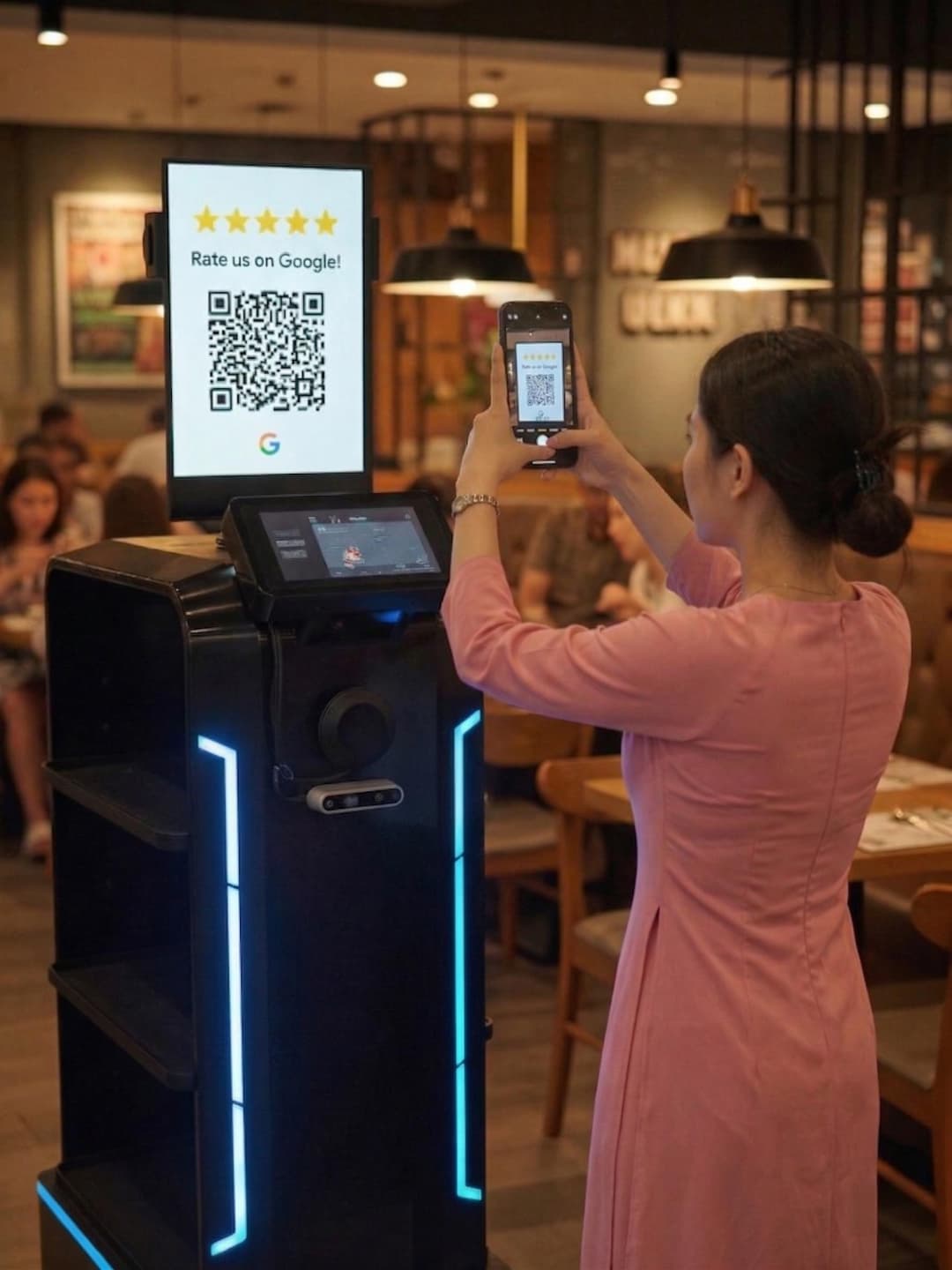
For restaurants that have deployed food delivery robots, there's an interesting opportunity here. When a robot arrives at a table, customers are naturally paying attention to it. It's novel, it's interactive, and they're already in a moment of positive engagement with your restaurant.
The FL1 by FoodLink System includes a Google Review Boost feature: at table arrival, the robot can verbally prompt satisfied customers for a Google review and display a QR code on its 10.1" interactive screen. The ask happens when the food arrives and the customer experience is at its peak.
One of FoodLink System's current clients, Uncle Five Coffee, saw their review count grow significantly in the first month after deploying the FL1. The consistent, in-the-moment prompting makes a real difference compared to relying on staff to remember to ask.
This isn't magic. The reviews still need to be earned through genuinely good food and service. But the prompting mechanism ensures the ask happens consistently, at the right moment, without depending on your team's bandwidth.
Learn more about how the FL1's marketing features work on the FL1 page or read why restaurants are choosing FoodLink System.
What not to do
Don't offer incentives for reviews. Google's guidelines prohibit incentivised reviews ("leave us a review and get a free drink"). If Google detects this pattern, reviews can be removed and your listing can be penalised.
Don't buy reviews. Fake review services have become more sophisticated, but Google's detection has too. A caught fake review campaign can get your listing suspended. It's not worth it.
Don't ask for reviews in bulk emails to your full contact list. Google can detect sudden spikes in review volume from unusual sources and may filter them out. Organic, steady review accumulation over time is worth more than a spike that triggers suspicion.
Don't ignore negative reviews. A thoughtful, professional response to a negative review often does more for your reputation than the negative review itself does damage. Potential customers see how you handle problems.
Building a review culture in your restaurant
The restaurants with the most Google reviews aren't running aggressive campaigns. They've made asking for reviews normal, for the team and for the customers.
It starts with the owner or manager modeling the behavior: asking personally, talking about reviews in staff briefings, celebrating milestones. When your team sees you taking it seriously and sees it making a difference (more visibility, more walk-ins), they take it seriously too.
Set a simple target: "We want to get to 100 reviews by end of quarter." Check in on it weekly. Treat it as a business metric, because that's exactly what it is.
If you'd like to explore whether the FL1's automated review prompting could help your restaurant, get in touch with us for an honest conversation about what to expect.
Frequently Asked Questions
Q: How many Google reviews does a restaurant need to be competitive?
It depends on your local market. In a suburban area with less competition, 50 reviews might put you among the top-reviewed restaurants in your category. In a competitive urban area with hundreds of similar options, you might need 200+ to stand out. The best benchmark is to look at what your top local competitors have and aim to match or exceed it over time.
Q: Can I ask customers to change their review if they gave a low rating?
You can reach out to a customer who left a negative review to address their concern, and if the issue was resolved, they may choose to update their review voluntarily. You cannot pressure them to change it, and Google's guidelines prohibit directly asking customers to alter or remove negative reviews. Focus on resolving the issue genuinely, and leave the review decision to them.
Q: How long does it take for a new Google review to appear?
Most reviews appear within a few hours of being posted, though Google's spam filters may hold some back. If a review from a genuine customer doesn't appear after a few days, there's unfortunately not much you can do. Google's review moderation isn't transparent. This is another reason why consistent, ongoing review generation matters more than any single review.
Q: Does responding to Google reviews help my ranking?
Google has confirmed that responding to reviews is a positive signal for local search ranking. Beyond the ranking benefit, responses increase trust with potential customers who see you're an engaged operator. It's a habit worth building regardless of the ranking impact.
Q: What should I do when I get a fake or competitor-placed negative review?
You can flag a suspicious review to Google via the "Report a review" option. Document why you believe it's fake: the person was never a customer, the review matches a pattern of competitor sabotage, and so on. Google's review team investigates, though response times can be slow. In parallel, respond to the review professionally. That's often more effective at protecting your reputation than waiting for the removal process.