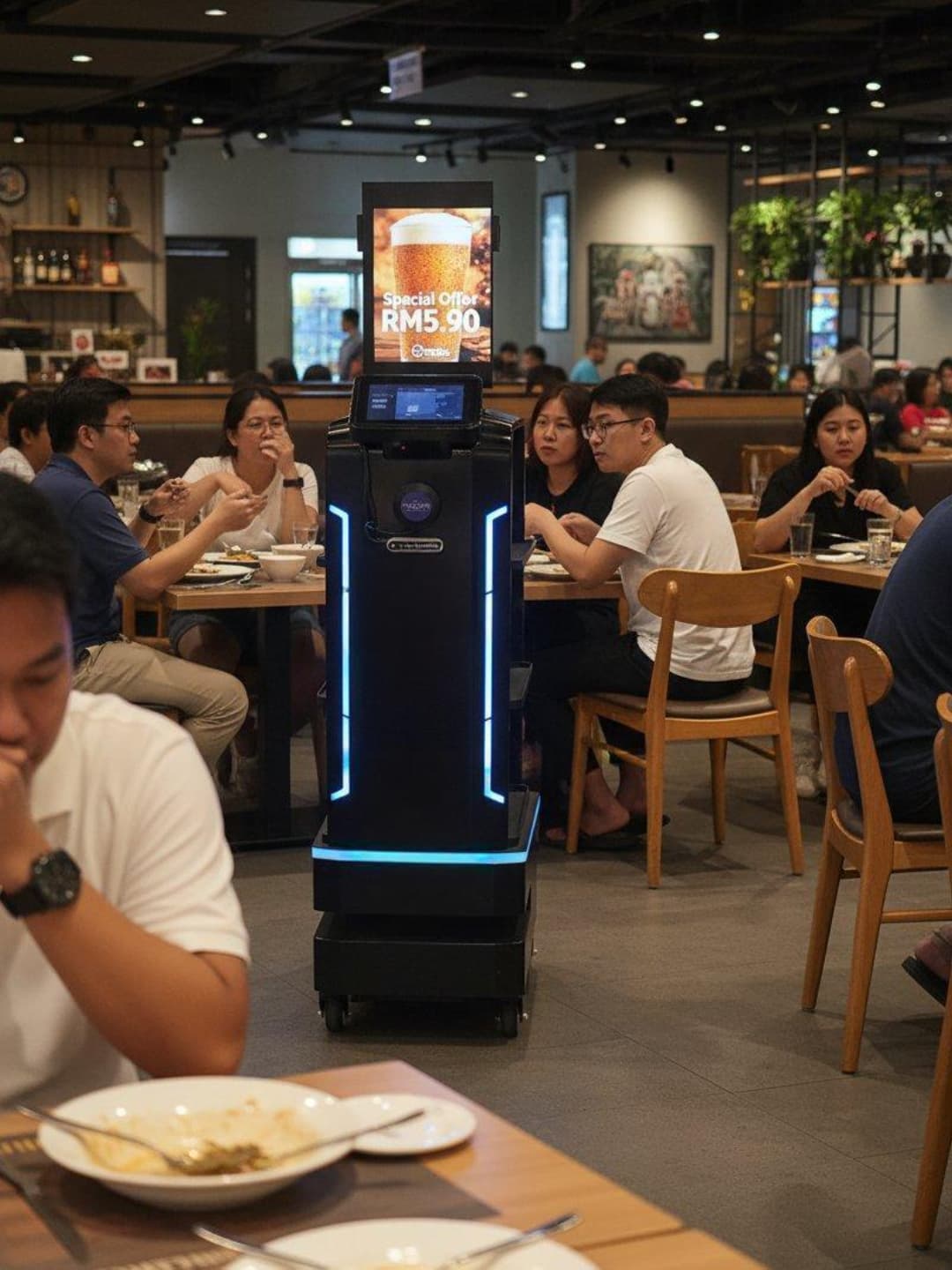
If you've walked through a Malaysian mall food court recently, you've probably seen a robot gliding between tables. They're everywhere now. But seeing one and knowing whether one makes sense for your restaurant are different questions.
I've put together what you actually need to know before committing to a lease or purchase. The technology differences, the real costs, and the questions most suppliers won't bring up first.
What is a food delivery robot?
A food delivery robot is a self-navigating robot that carries food from your kitchen to customer tables without a staff member walking it over. You load the tray, tell it which table, and it goes. When it's done, it comes back for the next order.
The newer ones aren't following a fixed track. They build a map of your restaurant and navigate around whatever's in the way. Moved chairs, kids running past, bags on the floor. Your staff stops making round trips and gets that time back.
Navigation technology: QR codes vs LiDAR SLAM
This is the single most important spec to understand. Everything else is secondary.
QR code and magnetic track systems
Older and budget robots follow physical markers: QR codes on the ceiling or magnetic strips in the floor. The robot follows these markers like a train on rails.
The problem: you're locked into a fixed path. Move your tables for a weekend event? You might need to move the ceiling markers too. A staff member standing in the wrong spot can block a QR code and confuse the robot. And depending on your tenancy agreement, sticking markers on the ceiling might not even be an option.
LiDAR SLAM navigation
LiDAR SLAM (Light Detection and Ranging + Simultaneous Localisation and Mapping) is the newer approach. The robot fires laser pulses to build a 3D map of your restaurant and updates its position in real time as it moves.
What this means in practice: no ceiling markers, no floor strips, no renovation. The robot learns your layout in a setup session and navigates from memory, rerouting around obstacles on the fly.
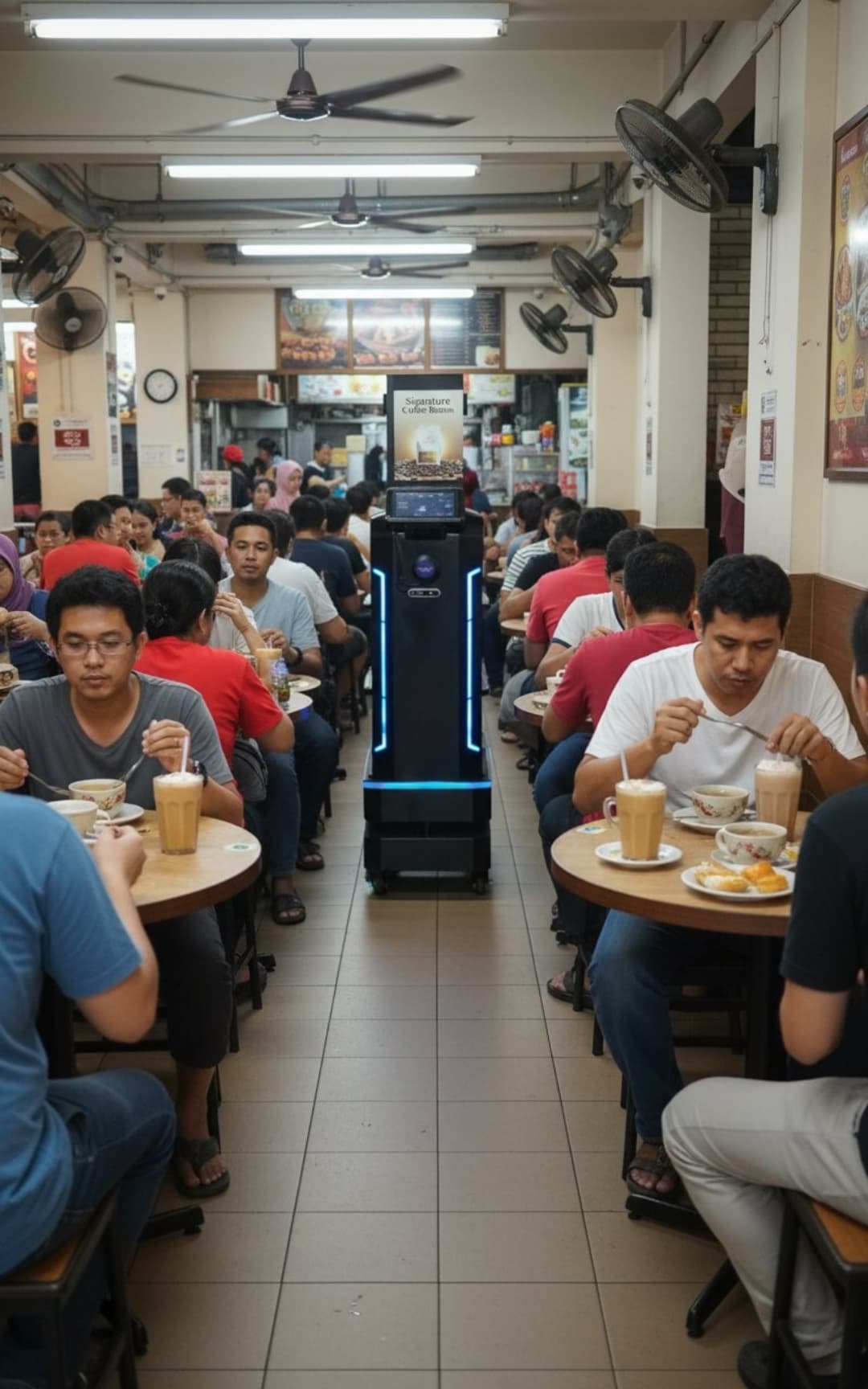
This matters for Malaysian restaurants specifically because layouts tend to be compact, seating is dense, and plenty of kopitiam and cafe operators rearrange tables for weekend crowds or events. A robot that can't handle a shifted layout is useless half the time.
The FL1 by FoodLink System uses LiDAR SLAM with 3D depth cameras and ultrasonic sensors to detect obstacles at different heights. Not just furniture, but bags on the floor, people stepping back from tables, and kids running around.
What to look for when evaluating a robot
Passage width
Malaysian restaurant layouts, especially kopitiam and cafe formats, are tight. A robot that's 60 to 70cm wide will struggle. Look for passage width under 50cm. The FL1 is rated for 46cm passage width with 44cm narrow-aisle capability, specifically engineered for Southeast Asian restaurant layouts.
Payload capacity
How much can it carry per trip? This determines how useful it actually is during a busy service. Three trays at 15KG each (45KG total) is a practical benchmark for a full-service restaurant. Single-tray robots require more round-trips and are less efficient.
Battery life and charge time
A robot that needs a 6-hour charge after 4 hours of operation is a problem during a double-shift dinner service. Look for robots that can run a full operating day, 12 to 15 hours, on a single charge, with a charge time of 3 to 4 hours that can happen during off-peak periods.
Operating modes
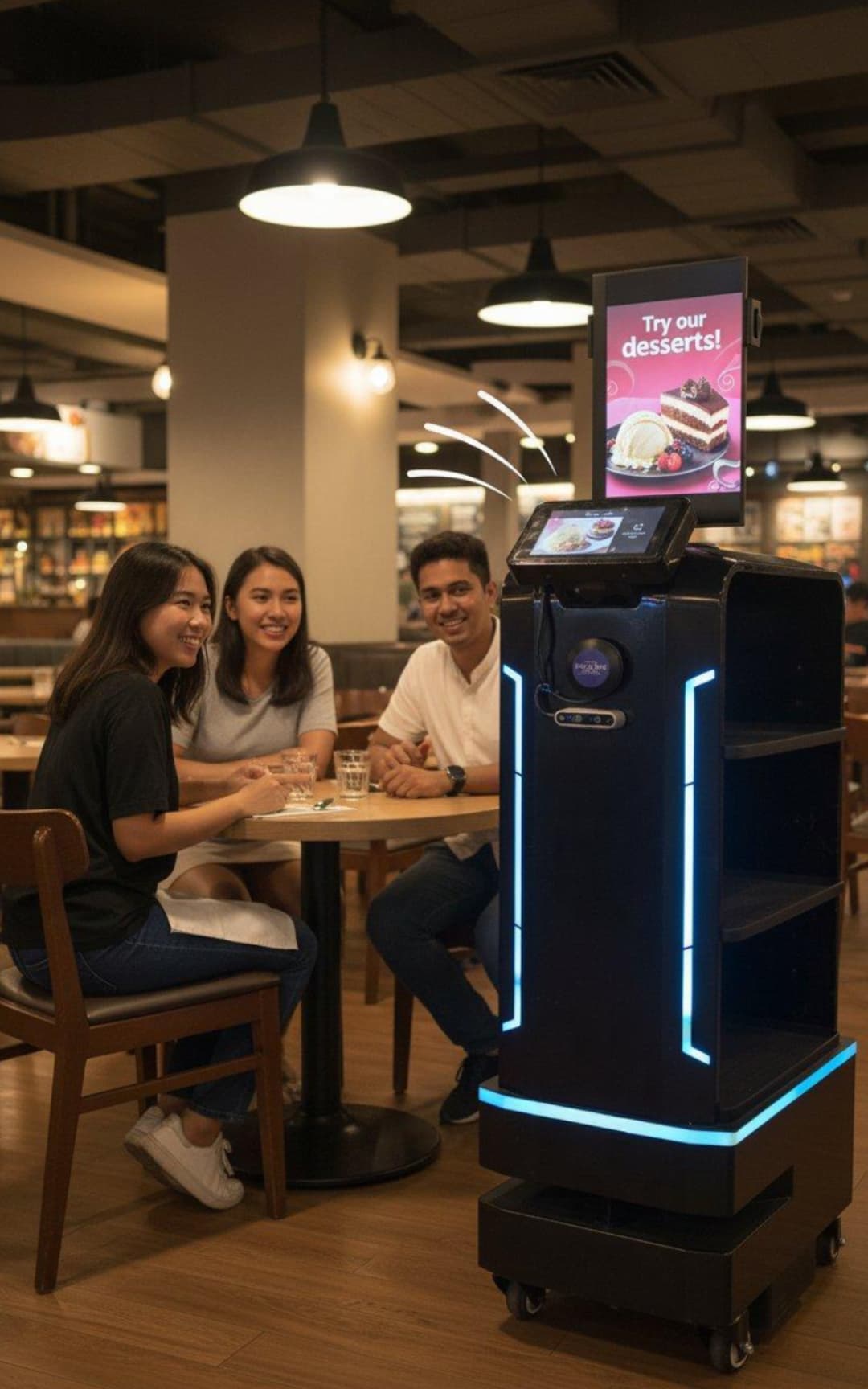
Not all robots are just food runners. More capable systems include cruise mode (roaming autonomously for marketing or upselling), dish collection mode, birthday or celebratory mode, and usher or guest-guiding mode.
These additional modes determine whether the robot is a single-function tool or something that creates value beyond plate delivery.
Software and customisation
Can you update table layouts yourself? Can you change the robot's behavior, voice, and marketing content? Or do you need to call the supplier every time something changes?
This matters in practice. Restaurants change. Menus change. If you're locked into a vendor who charges extra for every software update, that adds up over a year.
Support model
This is where many operators get caught out. Some robot suppliers operate through dealers, meaning when you have a problem, the chain is: you, then the dealer, then the supplier. Response times suffer and accountability gets murky.
Ask specifically: who do I call when there's an issue? Is support included in the lease? What's the response time commitment? FoodLink System operates direct, no dealers or middlemen, with a local Malaysia and Singapore engineering team for remote and on-site support.
What does a restaurant robot actually cost in Malaysia?
Pricing varies by supplier, navigation technology, and feature set.
For a lease model, the most common for Malaysian operators who want to test before committing, expect to be in the range of RM 1,500 to 2,500 per month for a capable LiDAR SLAM robot with software support included. Outright purchase options typically run RM 50,000 to 100,000 or more depending on specification.
The FL1 is offered on a lease with pricing tailored to your venue and needs. FoodLink System starts every venue with a 3-month pioneer phase: you can cancel anytime in those 3 months, with no penalty. If it works, it continues as a 12-month lease. That kind of structure is worth looking for specifically because it removes the risk of a long-term commitment before you've seen how the robot actually performs in your space. Contact FoodLink System for a tailored quote.
More details on how FL1 and Pip start at a new venue are on the FL1 product page.
Common questions restaurant owners ask before buying
Will it confuse my customers or put them off?
In practice, the opposite tends to happen. Novelty drives engagement, particularly in the first weeks of deployment. Customers photograph the robot, share it on social media, and talk about it. Over time it becomes part of the restaurant's identity rather than a gimmick.
What if the robot breaks down during a busy service?
Your team runs the service manually, as they always have. A well-run restaurant shouldn't depend on the robot to function, it should improve operations, not become a single point of failure. This is also why support response time matters: you want a supplier who can diagnose and fix software issues remotely, often same day.
Do I need to renovate my restaurant?
For LiDAR SLAM robots: no. The robot maps your existing space. For QR or track systems: yes, you'll need installation work. That's a meaningful cost difference to factor in when comparing options.
Can it handle my restaurant's specific layout?
The only way to know for certain is a site assessment. Any reputable supplier should do this before selling or leasing to you, measuring aisle widths, mapping the floor plan, and identifying any potential navigation challenges.
If you'd like a site assessment for your restaurant, get in touch with us and we'll arrange one at no cost.
Frequently Asked Questions
Q: What is the difference between a food delivery robot and a robot waiter?
The terms are often used interchangeably. In practice, both refer to the same category of autonomous mobile robot designed to transport food from kitchen to table. Some systems also take orders via a touchscreen, which blurs the line further. The core function, autonomous food transport, is the same.
Q: Can food delivery robots work in outdoor restaurant settings?
Most current food delivery robots are built for indoor use. Outdoor environments introduce variables, uneven ground, wind, rain exposure, and GPS interference, that most indoor AMR systems aren't designed for. If you operate an outdoor or semi-outdoor space, ask specifically about this during your evaluation.
Q: How long does it take to set up a food delivery robot in a new restaurant?
For a LiDAR SLAM system like the FL1, deployment is typically 1 to 3 working days: site mapping, configuration, testing, and staff training. QR-based systems may require more time for infrastructure installation. FoodLink System's stated target is 48 hours from unboxing to fully autonomous operation.
Q: Is there a minimum restaurant size for a food delivery robot to make sense?
There's no hard minimum, but the economics work better for restaurants with consistent table turnover across multiple sessions per day. A high-volume cafe doing 100 or more covers per day is a better candidate than a small fine-dining operation doing 20 covers an evening. That said, it depends on the specific layout and staffing situation, a site assessment is the most reliable way to get an honest answer.
Q: What happens if the robot gets stuck during service?
Modern LiDAR SLAM robots are built to handle dynamic obstacles. If genuinely stuck, the robot will alert staff, typically via the display or an audio prompt, and can be manually guided back to position. A trained team should be comfortable handling this in under a minute.